
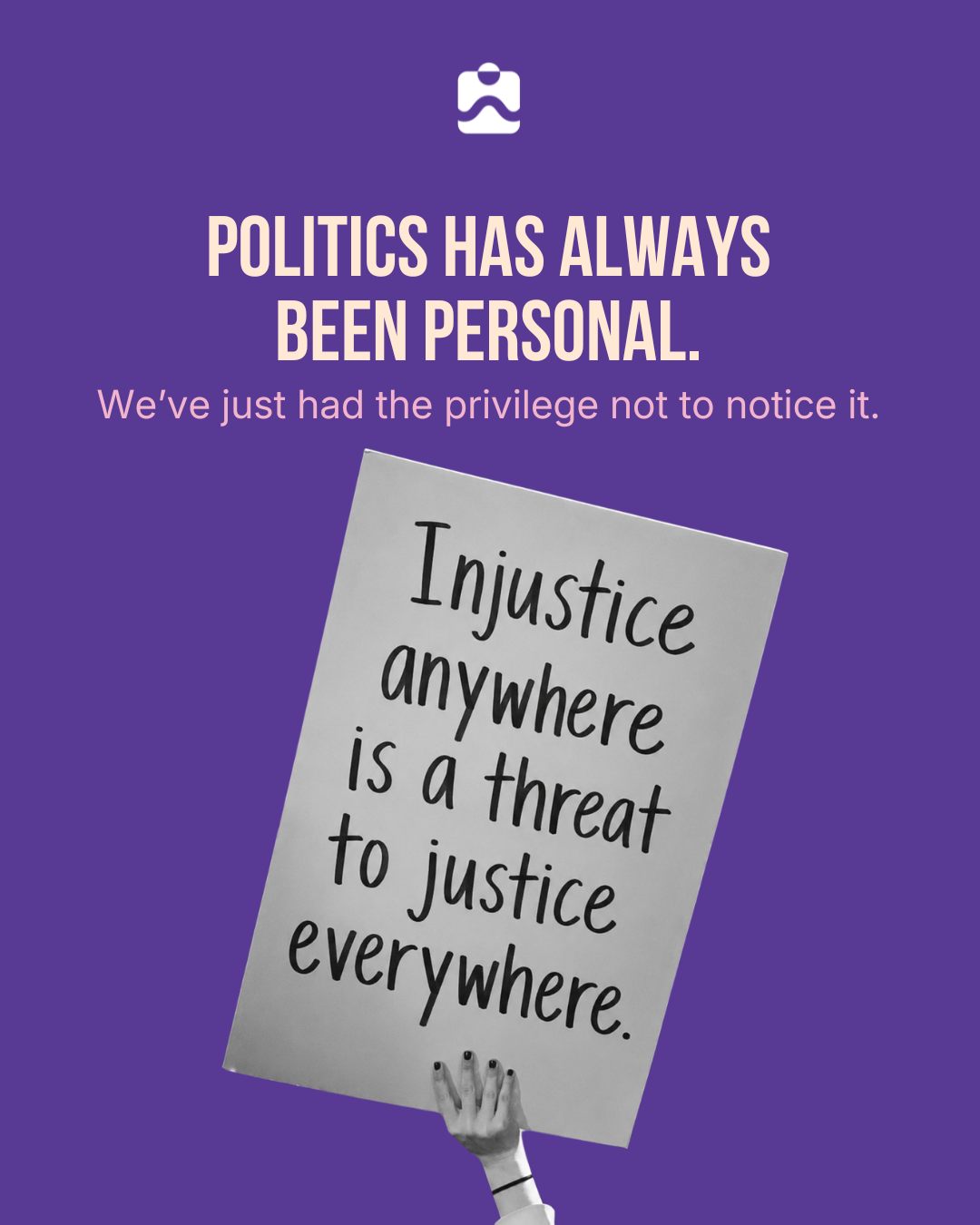
We Have Just Had The privilege To Not Notice it
There is something deeply hopeful about watching young people finally say they have had enough. What began as the Cockroach Janta Party, an online satire against the contempt shown towards unemployed young Indians, has become a wider movement demanding accountability for examination failures, shrinking opportunities and a system that repeatedly gambles with students’ futures. Sonam Wangchuk’s hunger strike gave this anger another powerful centre, and his forced removal to the hospital only exposed the government’s instinct to control a protest rather than address its cause. When protesters marched towards Parliament, they were met with barricades, batons and tear gas. Nearly 180 people, were reported injured.
For years, young people have been told that politics is dirty, distant and irrelevant to ordinary life. We were encouraged to focus on our studies and careers, as though politics did not determine the conditions under which either would exist. Yet politics decides whether an examination is fair, whether a degree leads to employment, whether a family can afford healthcare, whether a woman is safe, whether a community keeps its land and whether the police protect citizens or those in power. Politics was always personal. Some of us were simply privileged enough to pretend it was not.
There is hope in this awakening, but there must also be humility. Women, Dalit, Adivasi, Muslim, Kashmiri, Farmer, Queer, Disabled, and other marginalised communities have been telling us for generations what happens when they challenge the state. They have been beaten, detained, surveilled, vilified and criminalised for demanding land, dignity, safety and justice. The violence did not suddenly become real because it reached students in Delhi. It became visible to more privileged Indians. If we are shocked now, we must confront how easily we dismissed other movements when the people facing the batons did not look like us. Solidarity cannot begin and end with the thought that this could happen to me. It must mean believing that even when it is not happening to us, it should not happen to anyone. It means remembering that injustice anywhere is a threat to justice everywhere.
The government is not simply failing to listen. When a state can mobilise force faster than it can organise an honest negotiation, that is not administrative incompetence. It is a political choice. We saw the same pattern in Madhya Pradesh, where Adivasi families protesting displacement and rehabilitation failures linked to the Ken–Betwa project were cleared from their protest site. We saw it again when Wangchuk was removed from his hunger strike and hospitalised against his wishes. Authorities may describe such actions as concern, but concern without meaningful engagement is performance. A government cannot ask people to stop fasting while refusing to address what forced them to put their bodies on the line.
The most urgent question is simple: where is the accountability? Protesters have posted about police personnel without visible name tags beating young students and physically and sexually assaulting women and young girls. These are deeply disturbing and require an immediate, independent investigation. A uniform cannot become a shield against scrutiny, particularly when the person wearing it is exercising the coercive power of the state. No democratic government should expect citizens to accept officers using violence without consequence. If citizens are expected to follow the law, those enforcing it must be held to an even higher standard.
We also need to speak honestly about the mainstream media. It is not enough to say that these protests have been covered. The question is how they have been covered, whose version has been treated as fact and whether the movement has been represented fairly. Protesters are often framed as unruly before their demands are explained. Official statements are repeated with authority, while the testimonies of injured citizens are treated as claims requiring endless proof. This bias cannot be separated from a media landscape shaped by concentrated corporate ownership, political connections and dependence on government access and advertising. When major media organisations are controlled by corporate actors whose commercial interests benefit from proximity to the government, the idea of an unbiased newsroom begins to collapse. A news organisation cannot meaningfully hold power accountable when those controlling it benefit from remaining close to that power.
This is why many young people are moving towards independent journalists and smaller digital platforms. We can see the difference between what is happening on the ground and what is being packaged for television. We can also see how a movement’s demands are erased while its protesters are reduced to a threat. This moment should make us revisit what mainstream media has taught us about earlier movements and marginalised communities. Protesters have repeatedly been called anti-national, terrorists, Khalistanis, Pakistanis or threats to national security. We are told who to fear before we are told what they are asking for.
Now that more privileged young people can see the same machinery operating against them in real time, it should make us question every convenient label we accepted in the past. Whose resistance did we condemn because a television anchor told us to? Whose pain did we dismiss because the media made their identity more important than their demand? How many communities were denied our solidarity because those in power successfully convinced us that questioning the government was equivalent to threatening the nation?
The lesson cannot only be that the media is biased when it misrepresents people like us. We must recognise how political and corporate interests have shaped which citizens we were taught to distrust and which institutions we were trained to believe without question. When we can now watch peaceful protesters being portrayed as aggressors despite videos showing violence against them, we must also reconsider what we were previously told about farmers, students, minorities, activists and communities resisting displacement.
Dissent is not the opposite of patriotism. Indifference and blind loyalty are. There is nothing patriotic or nationalistic about allowing a government to function without scrutiny simply because it is the government we voted for. Accountability is what makes a nation strong, and demanding it is both a citizen’s right and a citizen’s duty. Refusing to hold elected representatives accountable is profoundly anti-democratic and, I would argue, anti-national. I care about this nation, which is precisely why I refuse to confuse the nation with the government of the day. To love a country is to demand better from those temporarily entrusted with governing it. A nation is not its ruling party. It is its people, its institutions and the constitutional promises those institutions are meant to protect. It is always the power of people has to be stronger than the people in power.
The government should care about the nation too, rather than behaving as though protecting itself and protecting India are the same thing. They are not. No political party, prime minister or minister is the nation. They are elected public servants, temporarily entrusted with power and expected to serve the public interest, not themselves or a select circle of political and corporate allies. Any government that begins to believe it is the nation places itself above the citizens from whom its authority comes. That delusion is not patriotism. It is a threat to democracy.
But this rage a lot of us are experiencing cannot stay just for content. Governments know that public outrage often has a short life. A protest trends, police violence circulates, everyone posts, and then another crisis arrives. They keep misusing power because they know it will outlast our attention span. This moment must therefore translate into political memory and participation. Young people must vote, examine candidates beyond party branding, support independent journalism and question leaders even when those leaders belong to the parties they support.
Power is not frightened by people who are furious for three days. It is frightened by people who become informed, organised and difficult to distract. This movement gives me hope, but hope cannot remain a feeling we experience while scrolling. It must become solidarity, accountability, memory and participation after the streets have emptied. Politics has always affected our lives. The question is whether we are finally prepared to start affecting politics.